
Now that we know many uses of AI, we should address the most important risks that AI could bring to nonprofit organizations and how to reduce those risks.
This chapter will guide you through the essential steps of identifying, mitigating, and managing these risks.
Why risk management is different (and specially important) for nonprofits
Nonprofit organizations face a unique set of challenges and considerations when it comes to AI. The stakes are often higher and the resources are often tighter:
- Reputation as a key asset: Nonprofits thrive on public trust and are usually held to a higher ethical standard than other organizations. AI-related missteps can damage your reputation and impact your funding, volunteer recruitment and other key areas. This requires a proactive and thoughtful approach to AI ethics, going beyond simply complying with legal requirements.
- Resource constraints: Most nonprofits don’t have the massive budgets and dedicated AI teams of large corporations. This means that your approach to risk management needs to be simple and cost-effective.
- Vulnerable populations: Many nonprofits work with vulnerable populations who may be disproportionately affected by AI biases and errors. This requires extra vigilance in ensuring fairness, accuracy, and accountability in your AI systems.
We will give some brief recommendations for risk management on the following sections, taking into account the special needs of nonprofit organizations.
Key AI Risks for nonprofits
I have created a database with the risks that are more probable and impactful in the nonprofit context.
It includes many examples of how those risks can arise in common nonprofit tasks and useful tips to avoid or at least minimize those risks.
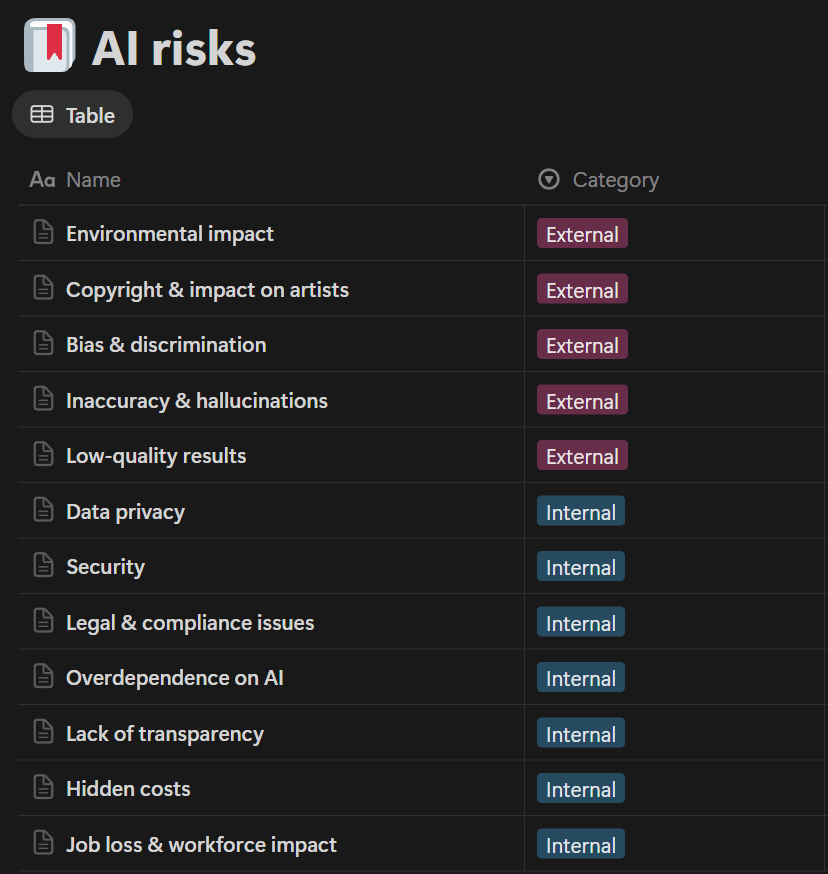
If you put your mouse over any name in the Name column, you will see an “OPEN” button. You have to click there to see all the details of each risk.

Common AI risks and practical safeguards
The following risks can affect nonprofit services, people, data, finances, and public trust. For each one, use the safeguards as a starting point and adapt them to the sensitivity and scale of the work.
🌍 Environmental Impact
AI models, especially Large Language Models (LLMs), consume significant energy for training and operation. For nonprofits focused on climate or sustainability, this can conflict with their values, especially if AI is used unnecessarily or inefficiently.
How to reduce this risk:
- Use AI only when truly useful
- Prefer local tools over cloud models
- Test small-scale before mass content creation
- Reuse and adapt existing AI outputs
- Turn off unnecessary auto-AI features
- Optimize prompts to reduce repetitions
- Schedule tasks during off-peak energy hours
- Discuss environmental trade-offs with your team
⚖️ Copyright & Impact on Artists
AI models are trained on vast amounts of existing data, often including copyrighted material. There’s a risk that AI outputs might inadvertently reproduce or be substantially similar to copyrighted works, leading to legal disputes and reputational damage.
How to reduce this risk:
- Understand how your AI tools were trained
- Pick tools with ethical licensing policies
- Avoid copying creators or distinct styles
- Carefully check all AI-generated content
- Give attribution where appropriate
- Keep records of AI content decisions
- Support human creators when possible
🤖 Bias & Discrimination
AI models learn from data, and if that data reflects existing societal biases, the AI can perpetuate and even amplify those biases. This can lead to unfair or discriminatory outcomes, which is particularly dangerous for nonprofits serving marginalized groups.
How to reduce this risk:
- Test AI regularly for unfair outputs
- Use inclusive and respectful language
- Include diverse data where possible
- Involve affected communities in reviews
- Avoid fully automated critical decisions
- Prefer explainable, bias-aware AI tools
- Log and share bias incidents internally
🤥 Inaccuracy & Hallucinations
AI tools, particularly LLMs, can sometimes generate incorrect or misleading information, often referred to as “hallucinations.” Relying on inaccurate AI outputs can lead to bad decisions, damaged reputation, or misallocation of scarce resources.
How to reduce this risk:
- Always fact-check AI-generated content
- Use AI tools with source search
- Share internal databases of reliable info
- Track recurring hallucinations in outputs
- Teach staff about AI limitations
- Test tools before critical use
- Set clear correction and review protocols
🗑️ Low-Quality Results
AI tools can sometimes generate content that is poorly structured, irrelevant, or simply doesn’t meet desired standards. This can lead to wasted time and resources in editing, redoing work, or publishing materials that damage professional image.
How to reduce this risk:
- Use detailed prompts and context
- Provide good-quality examples
- Use templates for consistent results
- Break down complex tasks in steps
- Track quality with performance metrics
- Train staff to improve AI use
🔒 Data Privacy
AI tools often require inputting sensitive information. Without careful handling, private data about donors, staff, or beneficiaries could be accidentally shared, leading to legal trouble, broken trust, or harm to vulnerable groups.
How to reduce this risk:
- Share only essential, minimal data
- Anonymize data before uploading
- Use secure, reputable AI tools
- Read tools’ privacy policies carefully
- Check data location and storage laws
- Prefer local AI for sensitive info
- Create a clear internal AI policy
- Prepare for potential data breaches
🛡️ Security
AI tools, like any software, can have vulnerabilities that cybercriminals can exploit, leading to potential breaches, data theft, or system compromises. For nonprofits, a security breach can expose sensitive data, disrupt operations, and severely damage public trust.
How to reduce this risk:
- Choose AI vendors with strong security
- Restrict access to data and tools
- Use individual logins, not shared accounts
- Keep local tools patched and secure
- Review and clean up AI integrations
- Define AI security and usage policies
- Create a clear incident response plan
🚨 Legal & Compliance Issues
AI tools can inadvertently lead nonprofits to break laws related to data protection, employment, fundraising, and more. Small nonprofits, often lacking legal teams, risk fines, reputational damage, or loss of status.
How to reduce this risk:
- Align use with local data laws
- Keep humans in key decisions
- Map legal risks for AI workflows
- Create compliance-focused AI policies
- Document decisions made by AI systems
- Track legal updates on AI regulations
🚶 Overdependence on AI
Over-reliance on AI can lead to a nonprofit losing critical human skills, decision-making capabilities, or the ability to function without AI tools. If an AI system fails, the organization could face significant disruption and become less resilient.
How to reduce this risk:
- Use AI as assistant, not replacement
- Encourage thoughtful human review
- Keep investing in staff skills
- Document how to work without AI
- Plan for AI outages and failures
🕵️ Lack of Transparency
AI tools often function as “black boxes,” providing results without explaining their reasoning. For nonprofits, this can create confusion, damage trust, and make it difficult to justify decisions to stakeholders.
How to reduce this risk:
- Label AI-generated public content clearly
- Be honest with partners about AI use
- Pick tools that show how they work
- Keep records of how AI operates
- Avoid opaque AI decision-making
- Assign responsibility for each AI system
💸 Hidden Costs
AI tools may appear cheap or free initially but can come with hidden costs, such as usage-based charges, integration expenses, and opportunity costs from staff time spent managing AI systems.
How to reduce this risk:
- Try third-party tools before custom ones
- Plan for future updates and costs
- Include all costs in budgeting
- Compare with non-AI alternatives
- Start small with limited AI tests
- Track usage and set alerts
- Consider open-source options
- Request nonprofit discounts where possible
- Avoid tools without good export data solutions
📉 Job Loss & Workforce Impact
AI tools can replace or reduce the need for certain roles, potentially displacing staff. For nonprofits, this can hurt morale, reduce trust, and contradict values around equity and community support.
How to reduce this risk:
- Use AI to support staff, not replace
- Discuss AI plans with your team
- Offer training in AI for all
- Help staff shift into new roles
- Appoint staff as internal AI champions
- Protect relationship-based roles
Prompts
You can use ChatGPT and similar tools (Google Gemini, Claude, etc.) to help you detect possible risks. Sometimes they give us ideas that we haven’t thought about. But always double-check the AI output, it might include irrelevant or even incorrect recommendations.
Remember that you can personalize the prompts (eg. mention if want to focus on specific topics, risks or tools) and give additional instructions according to the results you get (eg. “give me more details and examples about the risk X”).
You will see in yellow (starting with “>”) the lines where you should include your organization’s info. Feel free to add or remove lines if you think that will help you get better answers for your specific needs.
1. Identifying AI Risks for a Nonprofit:
You are an expert in AI risk assessment for nonprofit organizations.

I need your help to identify the top AI risks that our nonprofit should be aware of, considering our context explained below.

# Our context #

> Our mission:
> Our challenges:
> Our goals:
> Software that we use:
> Ethical considerations:

# Requirements #

Please explain the top 5 AI risks that are particularly significant for our organization and include the following info for each one:

1. Description
2. Why each risk is particularly relevant to our organization
3. Potential consequences or impacts of each risk.
4. Recommendations to mitigate each risk.
2. Addressing AI Bias and Errors with Vulnerable Populations:
You are an ethical AI consultant specializing in protecting vulnerable populations served by nonprofits.

I need your help to brainstorm scenarios where AI bias or errors could negatively impact our beneficiaries and develop mitigation strategies, considering our context explained below.

# Our Context #

> Our mission:
> Our challenges:
> Our goals:
> Software that we use:
> Ethical considerations:
> Vulnerable populations:

# Requirements #

1. Brainstorm 5 scenarios where AI bias or errors could have a disproportionately negative impact on our beneficiaries.
2. Develop specific mitigation strategies for each scenario, focusing on fairness, transparency, and accountability.
3. Evaluating Data Privacy and Security of AI Providers:
You are a data privacy and security expert specializing in AI vendor assessment for nonprofits.

I need your help to develop a set of questions to evaluate the data privacy and security practices of third-party AI providers, considering our context explained below.

# Our context #

> Our mission:
> Our challenges:
> Our goals:
> Software that we use:
> Ethical considerations:

# Requirements #

Please develop a list of questions that cover:

1.  Data storage practices.
2.  Data access controls.
3.  Encryption methods.
4.  Compliance with relevant data privacy regulations (e.g., GDPR, CCPA).
5.  Data retention and deletion policies.
6.  Incident response and breach notification procedures.
7.  Auditing and security certifications.
4. Checklist for Reviewing AI-Generated Content:
You are an ethics and quality assurance specialist for AI-driven content in nonprofits.

I need your help to develop a checklist for reviewing AI-generated content for potential biases, inaccuracies, and ethical concerns. Consider our context explained below.

# Our context #

> Our mission:
> Our challenges:
> Our goals:
> Software that we use:
> Ethical considerations:

# Requirements #

Please create a checklist that includes guidelines for:

1.  Identifying potential biases in language and representation.
2.  Verifying the accuracy and reliability of information.
3.  Ensuring compliance with ethical guidelines and organizational values.
4.  Implementing human review and oversight processes.
5.  Documenting review findings and corrective actions.
5. Crisis Response Plan for AI-Related Incidents:
You are a crisis management expert specializing in AI-related incidents for nonprofits.

I need your help to outline a crisis response plan for AI-related incidents, such as data breaches or ethical missteps, considering our context explained below.

# Our context #

> Our mission:
> Our challenges:
> Our goals:
> Software that we use:
> Ethical considerations:

# Requirements #

Please outline a crisis response plan that includes:

1.  Key elements for rapid response.
2.  Procedures for clear and transparent communication with stakeholders.
3.  Steps for effective remediation and damage control.
4.  Roles and responsibilities of key personnel.
5.  Protocols for internal and external communication.
6.  Post-incident review and learning processes.
Links
- AI Governance Framework for Nonprofits (great toolkit developed by Microsoft)
- Artificial Intelligence (AI) Ethics for Nonprofits (another good toolkit, by Nethope)
- Tools and guides for responsible AI (not specific for nonprofits, but useful anyway)
- A.I. Checklist for charity trustees and leaders (useful questions that you might want to ask in your organization)
- Responsible Prompting and Practices for Generative AI (brief Cheat Sheet by Beth Kanter)
- AIF360 & FairLearn (open-source tools for developers to improve fairness in AI systems)